

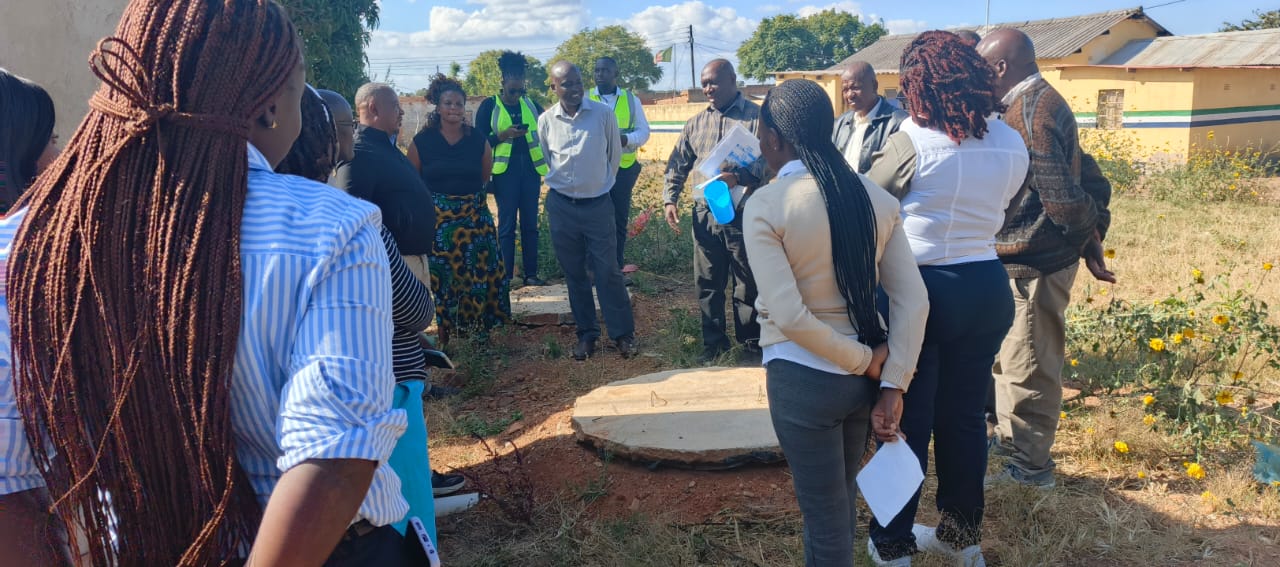
Government and other stakeholders in Monze District, Zambia gather for the District WASH Committee monthly coordination meeting to visit a local sanitation entrepreneur and discuss district efforts to strengthen sanitation markets (CARE Zambia)
At Agenda for Change, we believe that lasting progress in water, sanitation, and hygiene (WASH) requires more than effective programs. It requires strengthening the systems that provide, finance, and sustain those programs over time. That means shifting away from fragmented, donor-dependent interventions and toward approaches that are owned, led, and maintained by the governments, markets, and communities they serve.
It’s why we’re proud to highlight a recent piece from our member CARE, whose recent inquiry into scale is one of the more honest and practically grounded accounts we’ve seen of what systems thinking actually looks like when you try to put it into practice.
Despite decades of investment in programs that reach millions and replicate across geographies, the development sector has rarely produced solutions that grow big enough to solve the problems they set out to address. Promising pilots stall. Results remain tied to NGO implementation and philanthropic funding. CARE has been sitting with a harder question: what actually makes a project scalable in the first place?
Over the past few years, they’ve taken a closer look at their own work, examining what scales, what doesn’t, and why. The implication was clear: producing results is not the same as being scalable. And scalability cannot be an afterthought. It has to be built in from the start.
Designing for scale means designing differently
That realization has reshaped how CARE thinks about its work and its role. Rather than starting with existing programs and asking how to scale them, they now ask a different question upfront: can this model be operated, financed, and maintained by real-world systems (governments, markets, and local stakeholders) without continuous external support?
In practice, this means designing with the organizations that will ultimately own, fund, and run the solution from the beginning. It means prioritizing models that align with the incentives of the people who will carry them forward. And it means rethinking what success looks like. A simpler, system-integrated approach may take longer to design, but ultimately generates far greater results in the long term.
Why market-based sanitation?
Applying this lens led CARE to market-based sanitation (MBS) as their first test case.
Crucially, lack of safe sanitation is not primarily a technology problem; it’s a finance and market problem. Supply chains are weak, access to finance is limited, and the market conditions needed to sustain lasting solutions are often absent. MBS offers a way to address these constraints by developing local markets and supporting entrepreneurs to supply products and services communities actually need and want.
MBS also offered a practical entry point for testing a design-for-scale approach: it is less capital-intensive than other interventions, builds on existing markets, and has clear incentives for both government and private sector participation.
Working differently
Getting this right has required CARE to work differently across the board. They looked beyond their own models, revisiting the broader sector evidence with fresh eyes to identify approaches with the most compelling track records for both effectiveness and scalability. They approached MBS as a systems problem from the outset – engaging government, businesses, and community platforms to shape the model together, rather than designing independently and then seeking adoption. And they chose to partner differently, collaborating with fellow Agenda for Change member iDE, not to replicate their work, but to scale their proven model through local systems, combining complementary strengths.
Their role in this is intentionally time-bound: to support local actors to develop and own a model they can finance and evolve long after CARE steps back.
An open process
This work is ongoing, and CARE doesn’t expect to get everything right. But the questions they’re asking, and the way they’re trying to answer them, are relevant far beyond sanitation or any single organization. Those same questions are at the heart of what A4C exists to advance.
We’ll be following this series closely, and we’ll keep sharing the learning as it goes.
Read the full piece from CARE: https://www.care.org/our-work/case-studies/designing-for-scale-rethinking-what-and-how-we-build/
Follow the series: https://www.care.org/case-studies/tag/lean-market-based-sanitation-partnership-blog/