

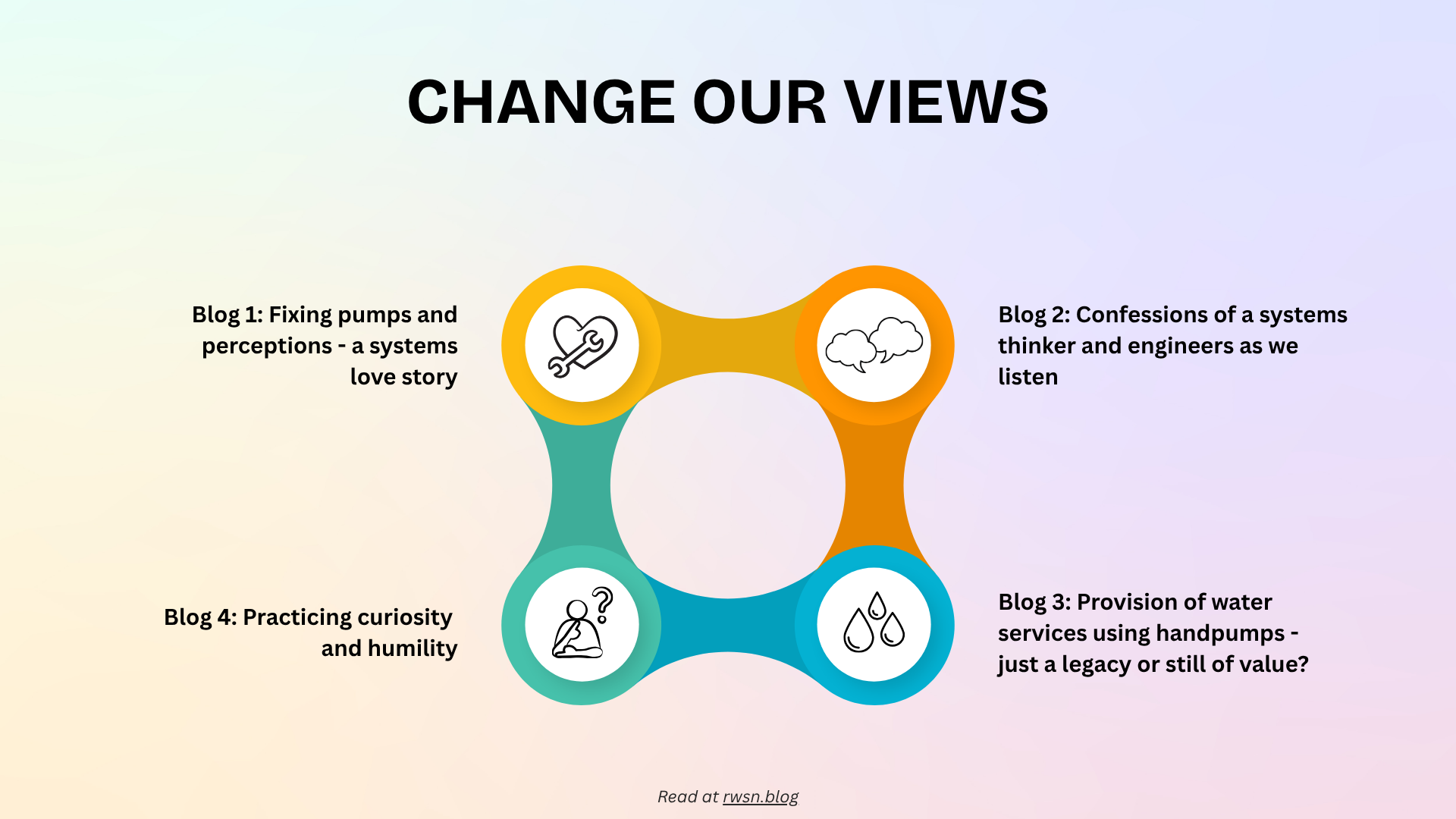
Over the past several weeks, our partner RWSN has published a four-part blog series called Change Our Views — a candid, ongoing conversation between Bethlehem Mengistu (Agenda for Change), Catherine McManus (The Water Project), and Kerstin Danert (Ask for Water), representing two platforms working toward the same goal from different starting points: Stop the Rot, focused on infrastructure quality, and us here at Agenda for Change, focused on systems strengthening.
What began as an online meeting between colleagues with differing perspectives turned into a year-long exchange, and four honest, thoughtful blogs exploring where engineering and systems thinking intersect, and where they still need to meet in the middle.
Fixing pumps and perceptions
The series opens with by defining that Stop the Rot is concerned with the quality of infrastructure, while Agenda for Change is rooted in systems strengthening. But as the conversation unfolds, it becomes clear the two are inseparable. A broken pump, Catherine explains, is rarely just a broken pump; it’s often a symptom of deeper issues, from unsuitable materials to weak oversight during construction. Bethlehem adds that infrastructure can’t be separated from the system around it: without financing, regulation, monitoring, and local ownership, even well-built infrastructure won’t deliver lasting services. The blog closes with a challenge to the sector: how do we tackle these issues collaboratively, in practice?
Confessions of a systems thinker and engineers as we listen
The second blog digs into the perceived divide between “the engineers” and “the systems people.” Bethlehem argues that engineering quality and systems strengthening are too often treated as separate concerns, when in reality every failed borehole is as much a governance failure as a technical one. Kerstin reframes the issue slightly, not as a divide, but as a lack of prioritization within organizations to get the basics right. Together, they land on a shared conclusion: the sector doesn’t lack knowledge of what works. What’s missing is turning that knowledge into consistent practice, incentives, and accountability.
Handpumps — just a legacy or still of value?
The third blog tackles a polarizing debate head-on: are handpumps an outdated technology, or still a vital part of the water access picture? Kerstin notes that roughly one in five people in Africa still rely on handpumps, and that number isn’t changing anytime soon. Rather than framing the debate as handpumps versus higher-level services, Bethlehem argues the real question is whether existing users are being protected and included in any transition, and proposes three guiding principles for a fair transition: recognizing current users and assets as integral (not temporary), aligning new investments with the institutions needed to sustain them, and explicitly addressing equity in who benefits first and who risks being left behind.
Practicing curiosity and humility
The final blog tackles the question of how small organizations, without national influence or large budgets, can participate in systems strengthening. Bethlehem’s answer reframes the whole conversation. Systems strengthening isn’t about scale, it’s about how organizations show up every day. Every organization, regardless of size, shapes the system through its choices, incentives, and behaviors. The real question isn’t “how can we influence the system?” but “how does our approach reinforce or challenge the system we want to create?” The series ends by noting that lasting change rarely comes from the largest actor in the room, it comes from those willing to work differently, and together.
Instead of presenting a single unified position, the series shows different perspectives in conversation, working through disagreement and nuance in real time. The result is a rare, honest look at what it actually takes to bridge infrastructure quality and systems strengthening — two approaches the WASH sector needs working together, not in parallel.
Read the full series here: Change our views