

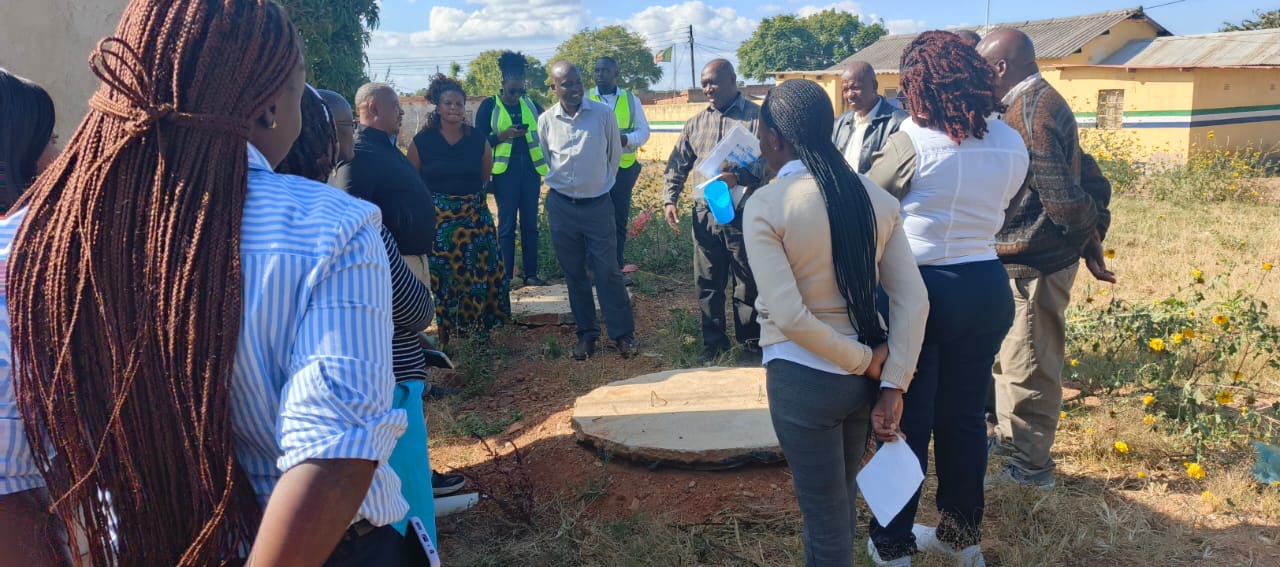
Monze District WASH Committee coordination meeting. Photo by CARE.
In case you missed it: Read our third blog in this series.
In our last post, we explored what it takes to build a sanitation model that can survive and grow under real-world conditions. But building a model that works is only part of the challenge. The harder question is: who keeps it going when external support ends?
For CARE Zambia, iDE, and IDinsight, the answer is increasingly clear: sustainable change depends on local ownership. Not government sign-off, not stakeholder engagement, not buy-in. Ownership: the ability of local institutions, businesses, and communities to shape, lead, finance, and sustain a sanitation system themselves.
Buy-in isn’t the finish line
Development programs often treat government buy-in as a sign of success. But support for an intervention does not necessarily mean local actors have the systems, resources, or authority to keep it going once external partners step back. So, what happens after? Can local government, utilities, businesses, and communities continue working together without being convened and resourced by an INGO?
That’s the shift the partnership is now actively testing in Zambia.
Work through what’s already there
Building ownership does not mean creating new structures. It means strengthening the ones that are already there.
In the MBS pilot, the partnership is working through three existing systems: the District Water, Sanitation, and Hygiene Education Committee (DWASHE); local financing mechanisms such as Savings Groups and Constituency Development Funds; and the Southern Water and Sanitation Company (SWSC). In May 2026, rather than convening a project-specific meeting, DWASHE members held their monthly meeting in Chisekesi and met directly with a local sanitation business owner. The visit helped them identify operational challenges and generate next steps that DWASHE members, not CARE, will lead.
Commitments becoming habit
Local stakeholders have already identified opportunities to promote sanitation products through agricultural events, traditional ceremonies, schools, churches, and community networks. The local government has committed to incorporating MBS into routine DWASHE meetings and monitoring, while SWSC has agreed to provide technical guidance on sanitation standards.
These are real commitments. But commitments are not yet habits. The pilot is now focused on exactly that transition: whether these roles can become part of how the system functions day to day, even as external facilitation fades. That’s a harder thing to measure than a signed MOU, and a more honest measure of progress.
What success actually looks like
The success of the pilot won’t be measured only by how many toilets are installed or whether the model operates while external partners are present. A stronger measure is whether local actors are committing their own budgets and staff time, taking initiative on next steps, and drawing on existing financing mechanisms to support sanitation without being prompted.
These may seem like modest signs, but together they point toward something bigger: a sanitation system that can function because local institutions, businesses, and communities have the ability and incentive to sustain it, not because an external program is holding it up.
After all, resilience isn’t just about surviving lean conditions. It’s about building something local systems actually want to carry forward.
Read the full blog from CARE Zambia and the CARE Water+ Team: From local buy-in to local ownership: What we’re learning about building stronger sanitation systems in Zambia
Landing page for the full CARE blog series: https://www.care.org/case-studies/tag/lean-market-based-sanitation-partnership-blog/