

On May 20, 2026, Agenda for Change brought together members, country representatives, and partners for an Open Assembly dedicated to one central question: does small-scale technical assistance actually contribute to systems change — and if so, what does it take?
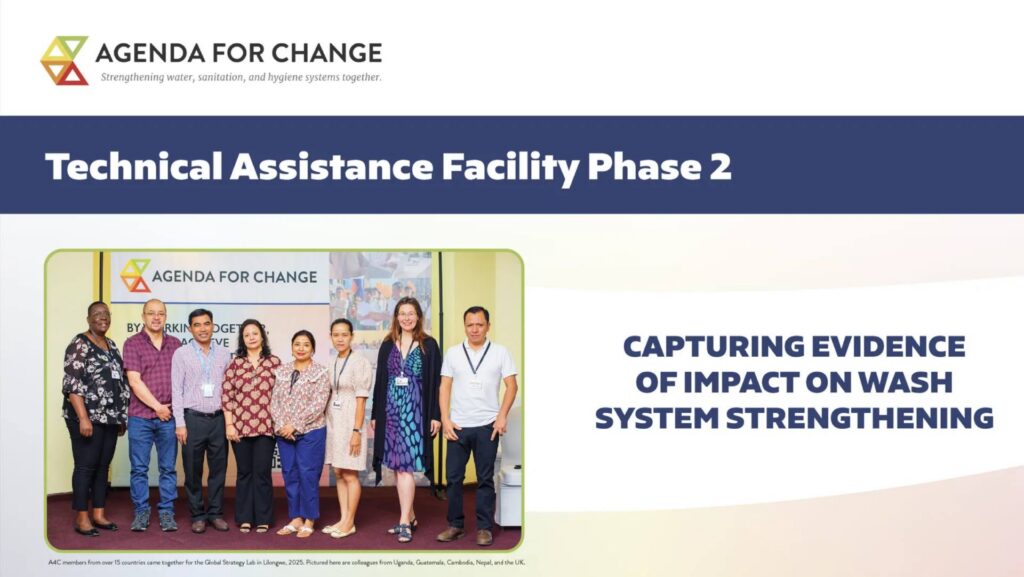
The session explored findings from the second phase of the Agenda for Change Technical Assistance (TA) Facility (2023–2025), a $450,000 investment supporting WASH systems strengthening across five countries. Three countries — Cambodia, Guatemala, and Rwanda — shared their experiences directly.
One Facility, Five Cases, Different Outcomes
Across five countries, activities are already demonstrably influencing practice and policy — yet progress in others remains uncertain or constrained by external factors. What makes the difference?
Two features stood out as critical: whether the TA is anchored in formal institutions and fully co-owned by government, and whether there is a clear rationale for how it will contribute to wider systems change.
Cambodia: Building the Next Generation
In Cambodia, the TA Facility supported two complementary initiatives — building block training for government staff and a Young Professionals Program for youth and university students. Together, they reached 20 young people and 37 stakeholders, with expansion planned to more districts.
The system change is already visible: training is being integrated into government programs, technical working groups are engaged, and participants are influencing resource mobilization and planning. The key learning: implementing through local organizations builds lasting capacity, and supporting youth to develop innovative solutions helps rejuvenate the sector.
Guatemala: Opening a Window of Opportunity
Guatemala is one of the few countries in Latin America and the Caribbean without a formal water and sanitation regulator — a gap identified as a critical bottleneck for transparency and sustainability. The TA Facility is supporting the legislature to establish a regulatory body, facilitating cross-country learning and assisting in drafting a bill.
The main change so far has not yet been regulatory — it has been institutional and political. The issue has entered the public agenda, a draft bill is in place, and multi-sectoral participation is growing. The key learning from Guatemala is clear: the government is the main actor, co-creation generates legitimacy, and systemic change takes time. Technical assistance worked better as a facilitator than as an implementer.
Rwanda: A Unified Roadmap for the Sector
In Rwanda, the TA Facility supported a WASH sector performance review and the development of a Multi-Year Action Plan (MYAP) for 2024–2029, owned by the Ministry of Infrastructure through the WATSAN Secretariat. The process engaged 50 stakeholders and produced a reference document that is already being used for planning and monitoring.
The MYAP syncs fragmented projects into one unified roadmap, prevents activity duplication, and directs funding to underserved districts. Partners have committed to specific activities, and work is already underway to develop a project for Green Climate Fund financing and a sanitation tariff framework.
What the Sector Is Taking Forward
For Agenda for Change, the commitments going forward are clear: design monitoring frameworks from the outset rather than as an afterthought, and be more intentional about when upstream TA is enough — and when it isn’t.
For the broader WASH sector, two questions remain open: how do we measure systems change from small-scale TA, and how do we ensure that TA reaches all the way to the people it is meant to serve?