

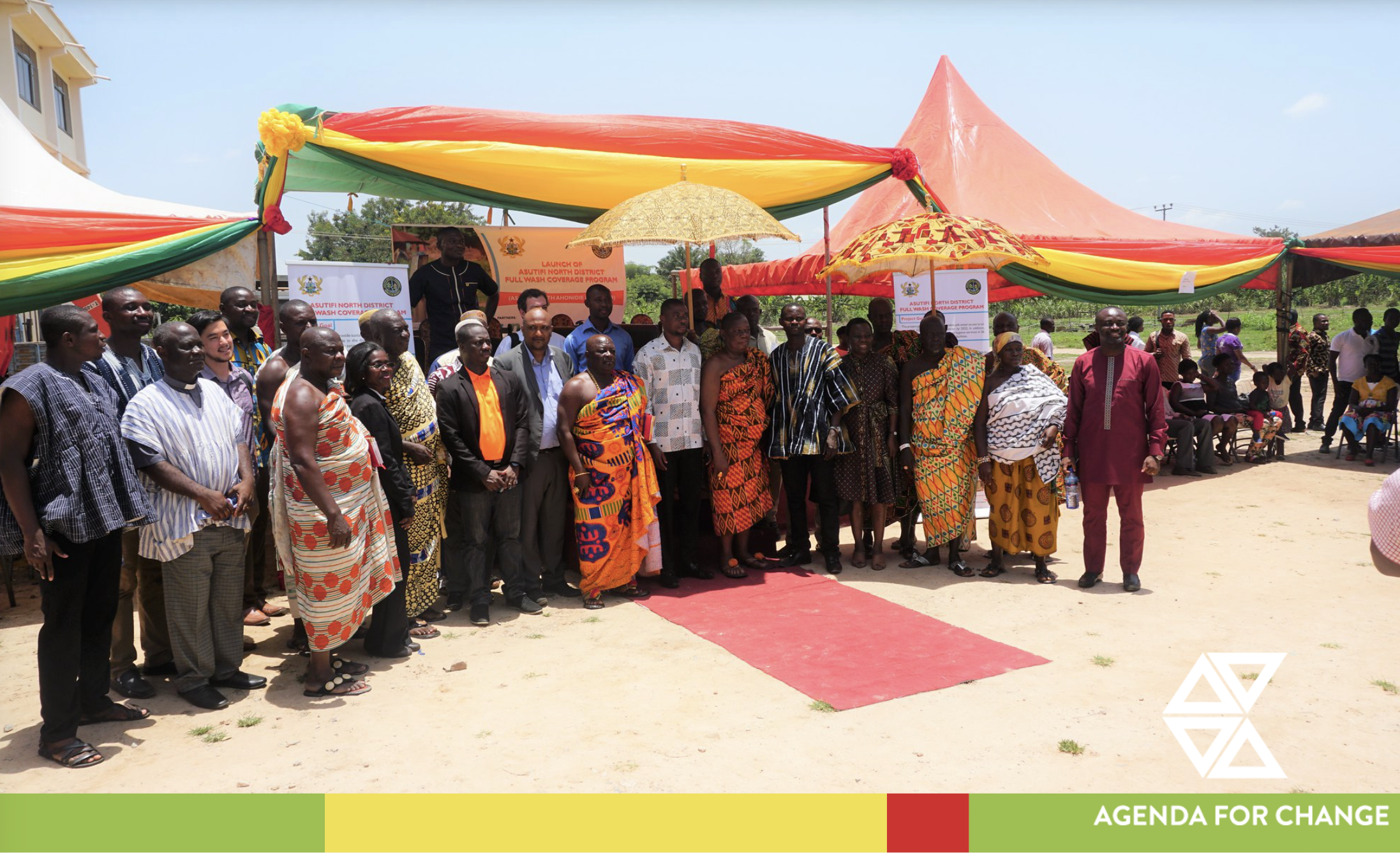
Asutifi North Ahonidie Mpontuo (ANAM) initiative partners celebrate the start of implementation of the WASH master plan in March 2019 (IRC).
How you plan matters as much as what you plan — that’s the argument at the heart of this new brief by Bill Twyman, Senior Water Supply and Sanitation Specialist at Aguaconsult, and Marieke Adank, Senior Programme Officer at IRC. It offers practical guidance for adapting district WASH master planning to local realities.
Developing a district (or area-based) WASH master plan is an essential starting point for a district-wide approach to sustainable WASH services. Done well, the process brings stakeholders together to understand the current situation, build a shared vision, agree on priority actions, and collectively plan for getting there.
Plenty of guidance already exists on how to run this kind of process. What’s often missing is a clear answer to a more practical question: how should that process change depending on where you’re working?
Drawing on Welthungerhilfe’s Global WASH Program experience in India, Pakistan, Sierra Leone, and Zimbabwe, together with insights and experiences shared by several Agenda for Change members — Water for People, WaterAid, IRC, and Water for Good — through their work in Rwanda, Cambodia, Bangladesh, the Central African Republic, Ethiopia, and Ghana, the brief sets out six contextual factors that shape not just the content of a district WASH master plan, but the entire process behind it — from situational analysis and visioning through to costing, implementation, and monitoring.
Why this matters
Guidance on WASH planning often implicitly assumes a best-case scenario — reliable data, engaged government, sufficient capacity. This brief starts from the opposite premise: that context should shape the plan from day one, not be treated as an obstacle to a standard template.
Read the brief in your preferred language: